
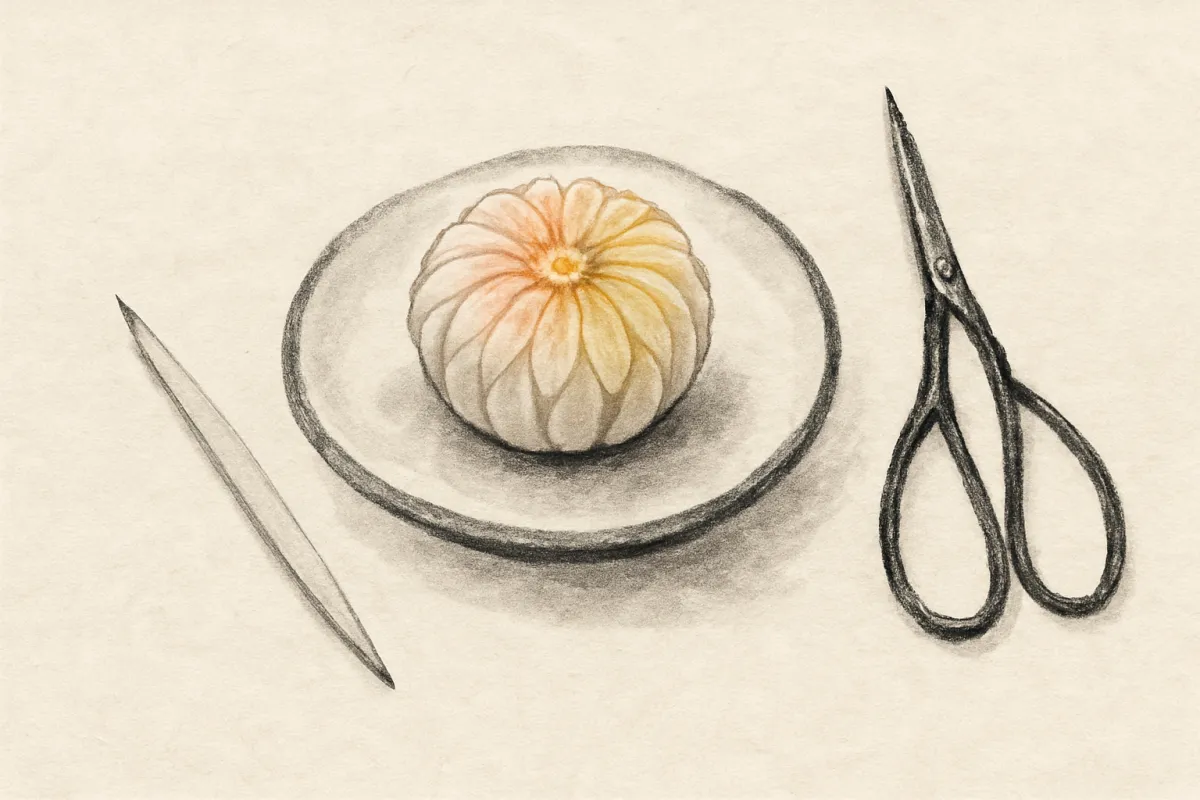
Nerikiri (練り切り) is a hand-sculpted fresh sweet, roughly the size of a golf ball, shaped into a peony or a maple leaf or a small white bird and set beside a bowl of matcha. It looks less like dessert than something carved. It is a seasonal art-sweet, and what it is and how a person shapes something so small and exact by hand turns out to be more specific than "edible art."
It starts from white bean, not red
Nerikiri is not made from red azuki paste, the fact most food writing skips. Its sculpting dough starts from shiroan, white-bean paste, made from white kidney-bean varieties. White is not an accident; it is the whole design. A pale, mild paste is a blank canvas that takes dye and added flavor cleanly, which is why nerikiri can be tinted into blossom-pink or leaf-green. When you bite one open you often find a hidden core of red koshian, the smooth strained bean paste, but the shaped outer body you were admiring is white bean. A menu that calls nerikiri "a red bean sweet" has it backwards: the red is the secret inside; the sculpture is white.
Plain bean paste can't hold a shape
Ordinary anko can't be sculpted, and the government's dossier explains why plainly: about 60% of the bean is starch, and koshian is made by lifting out the bean-paste particles, which wrap that starch, and coating them in sugar syrup without crushing them. That paste is meltingly smooth and has no viscosity. Koshian on its own, the document says, "cannot be made into a namagashi." It slumps; it won't take an edge.
That is why nerikiri uses kako-an, processed bean paste, rather than plain paste. You add a binder (tsunagi) that supplies the cohesion the smooth paste lacks, and the dough can suddenly be rolled, graded from one color into another, and pressed into a petal that stays a petal. Two traditional binders exist, both called nerikiri-an: gyūhi, a soft sugar-cooked glutinous-rice sweet (the same family that keeps mochi-style sweets pliant), or grated, steamed yam worked into white-bean paste. The yam road is the fussier, whiter one: steam the yam, push it through a fine sieve, wrap it in cloth and knead it, and repeat that last step three times to chase out every lump and drive up the whiteness. A common workshop ratio for the gyūhi route is about 500 g of shiroan to 30 g of rice flour and 60 of water; the binder is a small fraction of the mass, just enough to make sculpture possible.
"Kneaded and cut" is literal
The name is a set of instructions. Neri is knead; kiri is cut, and both verbs are meant exactly. Once kneaded to the right body, the dough is shaped with a small kit of tools, many of which "artisans handcraft their own": a wooden spatula (hera), a round rod (marubō), a triangular rod (sankaku-bō) for pressing crisp ridges like the vein down a petal, a silk cloth (fukin), a sieve, and a pair of steel chrysanthemum scissors (kiku-basami).
With that last tool, "cut" stops being a metaphor. To make a chrysanthemum, the maker cuts each petal individually with the scissors, dozens of tiny snips, and a single flower takes roughly four to five minutes from first cut to finish. An iris is built a different way: the paste is wrapped in the cloth and twisted tight to throw up the fold of the blossom, then the petals are finished with the fingertips. Color gradations, a bruise of purple fading to white, are blended by hand, not painted. The skill isn't in a mold; it's in those four minutes.
The steamed twin: konashi
Nerikiri has a near-identical sibling that reaches the same look by a different process: konashi (こなし). Instead of a paste-and-binder dough that's kneaded, konashi mixes wheat or rice flour into the bean paste and then steams it before kneading, which gives it a slightly chewier body than nerikiri's soft one. The same flowers on the same tea plate, made two ways: one kneaded, one steamed.
The split is usually told along a map, nerikiri belonging to Edo (Tokyo) and konashi to Kyoto, but that geography is the usual account, not a hard border; some sources trace nerikiri itself back to Kyoto. The reliable line is the process: knead versus steam.
A sweet with a poem for a name
The name of a nerikiri isn't edible at all. Each design carries a kamei (菓銘), a formal name drawn from classical poetry, seasonal words, old customs, places, or legend. You are meant to read it, not just eat it, and the name often announces a season a beat before it actually arrives.
The government dossier spells out two. A plum-blossom sweet named Kochi (東風, "east wind") points to Sugawara no Michizane, the scholar-statesman exiled to distant Dazaifu, who wrote to the plum tree in his old garden: let your fragrance travel on the east wind to where I am… remember it is spring, even if your master is away. An autumn-maple sweet named Tatsutagawa invokes Ariwara no Narihira and his image of the Tatsuta River running bright red with fallen leaves. To be handed a sweet called Kochi is to be handed a thousand-year-old poem about homesickness, folded into sugar and white bean.
Made to be eaten today
All of this is perishable on purpose. By water content, wagashi divide into namagashi (fresh, roughly 30%-plus water, eat within a day), han-namagashi, and dry higashi; nerikiri leads the fresh tier, a jōnamagashi, the high-grade, hand-sculpted, kamei-bearing kind. No preservatives, high moisture, made to order: that fragility is the value, not a flaw. It is the sweet of the tea ceremony, the omogashi eaten before thick tea to prime the palate and cushion the matcha.
In October 2022, Japan's Agency for Cultural Affairs registered the whole craft, "Namagashi with Kamei (Nerikiri/Konashi)", as a Registered Intangible Cultural Property, the third food tradition so honored after sake brewing and Kyoto cuisine. What the state chose to protect wasn't a building or a recipe but a skill: the shaping, cutting, and naming of sugared bean paste into a season you can hold for a day and then eat.
A small carved flower beside your matcha is white bean given a spine by a binder, cut petal by petal with scissors, and handed to you under the name of a poem. Ask the shop for its kamei.