
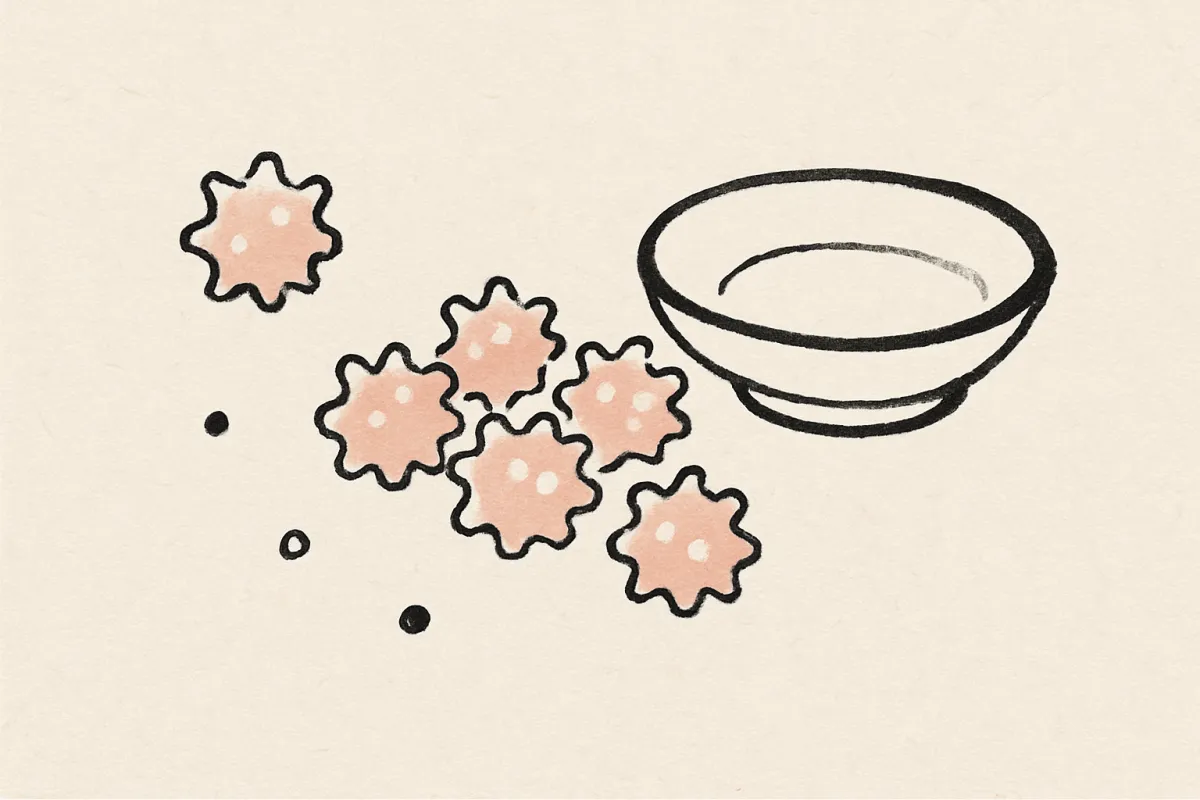
If you've seen Spirited Away, you've seen konpeitō. It's the little candy Lin tosses by the handful onto the floor for the susuwatari (the round black soot sprites), who scramble after it like popcorn. Maybe instead you met it as a jar of tiny, brightly colored, spiky sugar beads on a souvenir shelf and wondered what on earth it was. Two things about it tend to catch people off guard: konpeitō is Portuguese, and nobody makes its star shape. The spikes grow themselves.
A Portuguese candy with a Japanese disguise
The name gives away the origin. Konpeitō is the Japanese rendering of the Portuguese confeito, meaning a sugar-coated "comfit," from the same Latin root that gives English comfit and Italian confetti. The characters written for it, 金平糖, are ateji: phonetic stand-ins chosen for sound, not meaning. It arrived in the mid-16th century as one of the nanban-gashi (南蛮菓子, "southern-barbarian sweets"), the sugar novelties Portuguese traders brought through Nagasaki alongside castella.
In an era when sugar entered Japan as a rare imported near-medicine, a candy made of almost nothing but sugar was an elite object. The archetypal moment comes in 1569, when the Jesuit missionary Luís Fróis presented the warlord Oda Nobunaga with a glass bottle of konpeitō in Kyoto: sugar so precious it was a gift fit for the man trying to unify Japan. (The fuller story of how Portuguese ships and a "sugar road" turned sugar from medicine into sweets belongs to the castella chapter of the same trade.)
Nobody carves the points: they self-organize
Konpeitō is never molded or cut. Each piece starts as a single grain of zarame (coarse granulated sugar), historically a small seed of poppy or sesame, tumbling inside a huge heated copper drum called a 銅鑼 (dora): a shallow, gong-shaped kettle that can measure about 1.8 meters across, 44 centimeters deep, and weigh 800 kilograms. It turns slowly, roughly twice a minute, tilted around 30 degrees, in a room kept deliberately hot and humid (at least 55°C and 70% humidity) while the maker ladles a simple 3-to-1 sugar syrup over the tumbling grains.
For the first three days or so, the rolling only rounds the cores into smooth beads. Then, around the fourth day, tiny points called pocchi appear, and the key physics kicks in: fresh syrup clings to an existing bump more readily than to a flat gap. So every little protrusion preferentially collects the next layer and pulls ahead of its neighbors. This positive feedback loop selects and amplifies spikes instead of building a smooth shell. Where pieces collide inside the drum, the syrup bridges the contact points into new horns too, collisions the makers consider essential. The star shape emerges on its own from crystal growth, and the exact mechanism that settles each bead into its crown of horns still isn't fully understood.
That slowness is built in. Each bead gains only about a millimeter a day, layered up through hundreds of thin syrup coatings ladled on every few minutes, so a full run takes 7 to 13 days, usually about two weeks, with a craftsman standing over an 800-kilogram drum and adjusting the tilt and syrup by feel. Makers say the sense for reading that drum takes twenty years to acquire. That time was what made konpeitō valuable.
The candy the Emperor still gives
Because it was precious, konpeitō became ceremonial, and it stayed that way. Onshi no Konpeitō (恩賜の金平糖, "konpeitō bestowed by the Emperor") is konpeitō handed out in ornate little silver and lacquer bonbonnière boxes (from the French bonbonnière, "candy box") as an official gift from the Imperial Household. The custom traces to the commemoration of the 1889 Meiji Constitution and, from the 1890s, attached itself to imperial weddings and enthronements; it was the prescribed gift at the wedding of Akihito and Michiko. It has run unbroken for more than 130 years, long enough to outlast its sister gift, the bestowed cigarettes (Onshi no Tabako), which were quietly discontinued in 2006.
The cheerful star had a harder life, too. Konpeitō rode in military ration tins for its energy and morale value, and the modern Japan Ground Self-Defense Force combat ration still specifies a fixed mix: 8 white, 3 red, 2 yellow, and 2 green pieces, at least 15 grams. The classic five-color assortment (white, red or pink, yellow, green, and purple) is popularly read as standing for happiness, health, wealth, longevity, and posterity, which is why konpeitō feels celebratory and turns up at weddings, at the Hinamatsuri doll festival, and in emergency ration kits as a small piece of comfort.
Japan's last konpeitō house
If you want the real thing, there is essentially one address. Ryokujuan Shimizu (緑寿庵清水), founded in 1847 near Kyoto's Hyakumanben, is Japan's only shop devoted solely to konpeitō, run by the Shimizu family across five generations, from the founder Senkichi down to the current fifth-generation head. Its signature is flavor: sugar tends to seize and crystallize wrong when you add anything to it, and the house spent years learning to work around that to make konpeitō in flavors once thought impossible: cinnamon, tea, chocolate, wine, brandy, sake, tequila, yuzu, ginger, plum, plus seasonal runs. It uses a lighter, puffed glutinous-rice core rather than plain sugar, and a single limited flavor like its sake konpeitō can take years to perfect on top of the standard two weeks.
It hides in one more place: the Sugar Plum Fairy who pirouettes through The Nutcracker is, in Japanese, literally the "Fairy of Konpeitō" (金平糖の精). For the sweet that came ashore alongside it, see castella; for the wider family, the wagashi guide. Either way it stays the same object: a single grain of sugar that grows its own crown of stars, one slow millimeter a day.