
Doraemon, one of Japan's most famous cartoon exports, is a blue robot cat who inhales dorayaki by the boxful. His appetite for it is his defining trait, and it makes dorayaki the wagashi more people abroad can name than any other. Naming it and knowing it are different things, though. On a café menu it often arrives translated as "Japanese red bean pancake," or wrapped in a convenience-store package, and the obvious questions surface. What is that brown stuff inside, and why does everyone call a sandwich a pancake?
A sandwich, not a pancake
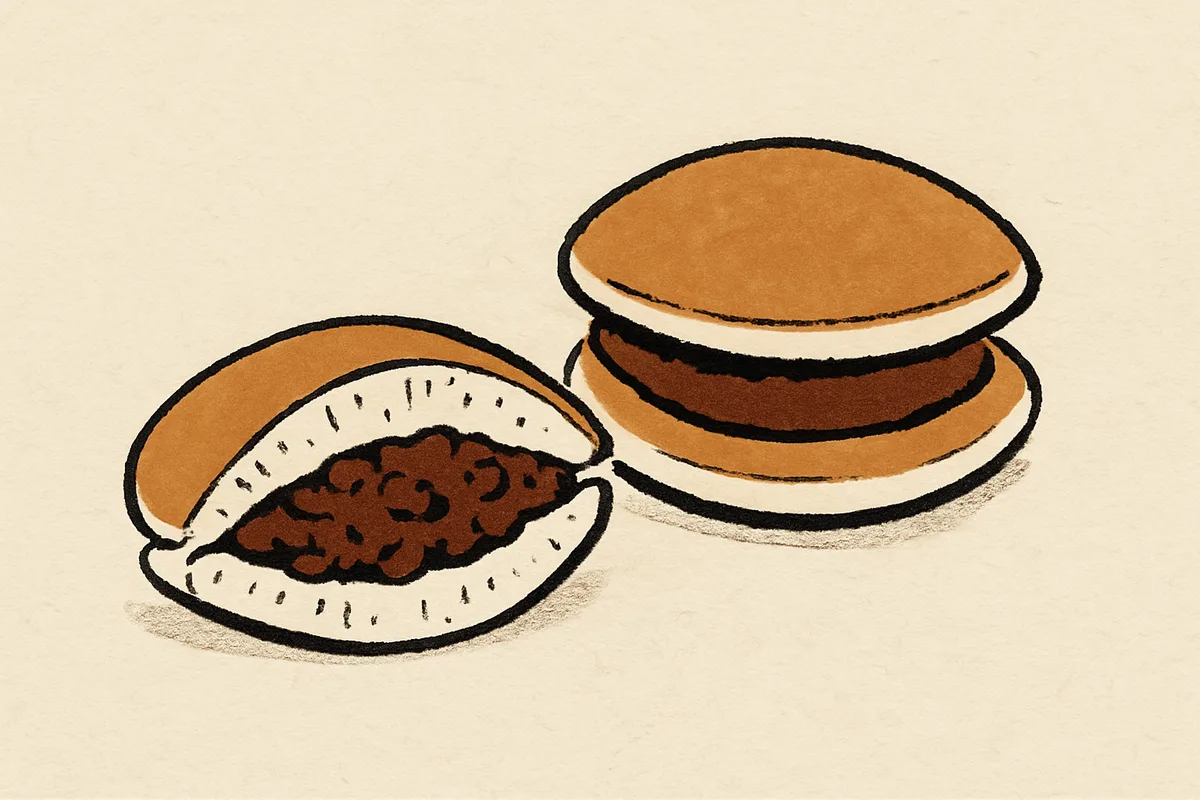
Dorayaki is two small, round sponge cakes with sweet azuki paste sealed between them. The word "pancake" mis-frames it twice over. First, structurally: a pancake is one flat cake you eat open-faced, while dorayaki is a closed sandwich, two lens-shaped discs pressed around a filling, browned on the outside and soft within. Second, by lineage: those discs aren't pancake batter. They're castella-family sponge (egg, sugar, and wheat flour), which is why the bite tastes cakey and faintly bready.
The filling is anko, sweetened azuki-bean paste, usually tsubuan (the chunky version that keeps some of the bean skins for texture), though smoother koshian turns up too. The one-line translation isn't "red bean pancake." It's closer to "a red-bean sponge sandwich."
One difference from castella proper stands out. Castella gets its rise entirely from whipped egg foam, with no chemical leavener at all. Dorayaki batter is leavened with baking soda. A typical recipe runs egg, sugar, cake flour, baking soda, mirin, and water, often with a spoon of honey for moisture. Same egg-sponge family, one deliberate addition. That's the difference between a cake meant to be sliced in a long loaf and two little cakes meant to be flipped on a griddle and clapped together.
The "gong-bake" name
Dora (銅鑼) is a bronze gong, the kind struck when a ship leaves port, and yaki means grilled or baked. So dorayaki is, literally, "gong-bake." Two folk explanations circulate, and they point at the same object: either the round, browned disc simply looks like a gong, or the batter was once cooked on a heated gong instead of an iron plate.
That second story blossoms into the legend most often told about the sweet. It stars Saitō Musashibō Benkei (1155–1189), the giant warrior-monk who served the tragic general Minamoto no Yoshitsune and is remembered for dying on his feet, riddled with arrows, still guarding a bridge. As the tale goes, Benkei, wounded and hiding at a farmer's house, left his gong behind when he moved on, and the farmer used it as a griddle to fry sweet batter: hence "dora-yaki." A variant has Benkei himself spilling bean paste onto a cake and inventing the thing by accident. Neither is documented; the historical Benkei is real, but the dorayaki story is folklore. There's a pleasure in it anyway: a mass-market snack anchored to one of Japan's most legendary swordsmen.
The sandwich is barely a century old
The dorayaki you know is a modern invention. The Edo-period version had no egg at all: bean paste wrapped in a single wheat-flour skin, folded into a square with the filling showing at the edges. Sources note it probably looked less like today's plump round sandwich and more like kintsuba, another old paste-and-skin sweet.
The round, two-sheet egg-castella form we picture only emerged around the turn of the twentieth century. The most-repeated attribution credits Usagiya, a shop in Tokyo's Ueno district, in 1914. That's the standard line rather than the last word. Who first made the round form is contested: the Nihonbashi shop Baikatei claims an earlier Meiji-era round dorayaki, and Kyoto's Sasaya Iori claims to have invented dorayaki at the request of a temple. What the sources agree on is the shape of the story: the two-sheet sandwich is an early-1900s thing, not an ancient one.
Mikasa, and the moon over the homeland
Order the same sweet in the Kansai region around Osaka and Kyoto and you may see a different name: mikasa (三笠). The round golden disc is read there as the full moon, and behind that reading sits one of the oldest homesick poems in Japanese. Abe no Nakamaro, an eighth-century scholar stranded studying in Tang China, gazed at the moon and wrote of longing for the moon "over Mt. Mikasa" back home near Nara. So in one region a gong-shaped snack; in another, the moon over the homeland. (Some sources give the plainer version, that "mikasa" simply nods to the gentle slope of Nara's Mt. Mikasa, which the cake's curve resembles.) Both readings point at the same mountain, so you can hold them together.
The cat that made it famous
Which brings us back to the robot cat. Doraemon, first serialized in 1969 by Fujiko F. Fujio, is written as helplessly devoted to dorayaki; in the lore, his passion begins when a dancing robot cat gives him his very first one. That running gag, broadcast across decades and dozens of countries, is the single reason "dorayaki" is the wagashi the world can name. (One thing to correct: Doraemon's name doesn't come from the sweet. It's nora, "stray cat," plus an old name suffix. The dorayaki is affection, not etymology.)
The everyday reality is humbler and part of the charm: dorayaki is easy to make at home with griddle batter and a can of anko, which is why it feels so familiar to many. Good specialty shops differentiate on the sponge and the paste: a moister batter here, a fluffier one there, brown-sugar sponge somewhere else. And if you find a chilled, cream-filled one labeled nama-dorayaki, that's the modern hybrid: whipped cream folded in with the bean paste, the variant that carried dorayaki beyond its all-anko past.
Behind the "red bean pancake" label is a gong-shaped sponge sandwich, about a century old, filled with the sweet bean paste at the heart of nearly every Japanese sweet.