
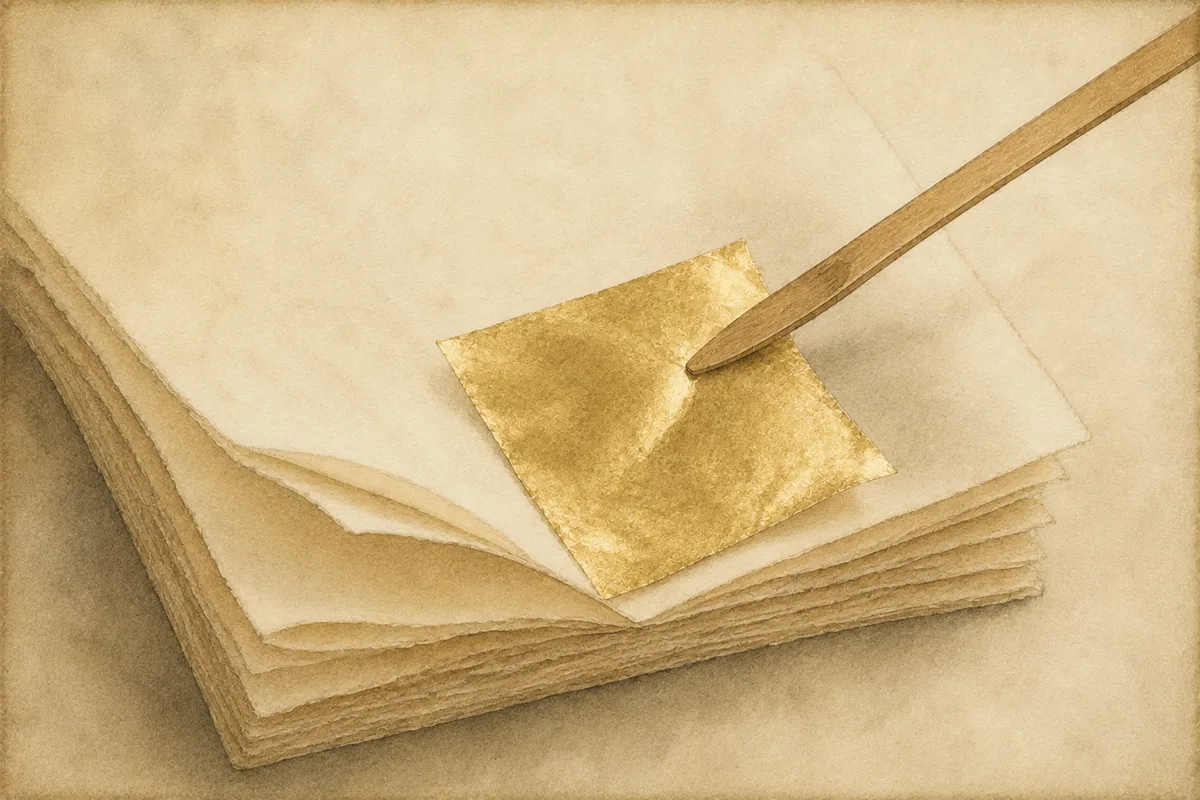
Making gold leaf sounds simple, which is how most people get it wrong. You put gold between sheets of paper, you hit it, the gold spreads. What is not obvious is which half of that sentence holds the difficulty. In Kanazawa, the city that produces over 99 percent of Japan's gold leaf, it is the paper, and the people who beat leaf for a living spend more of their working hours preparing paper than beating gold.
Gold is the easy part
Gold barely resists. A disc of gold alloy about 23 millimetres across can be worked out until it covers a whole tatami mat, roughly 1.6 square metres, and it will still be gold-coloured all the way across. The finished leaf runs to about 0.1 of a micrometre, one ten-thousandth of a millimetre.
The metal is not quite pure. Ishikawa's leaf makers work to fixed alloy grades, and the common no. 4 shade is 94.438 percent gold with 4.901 percent silver and 0.661 percent copper; the paler grades carry more silver, down to a half-and-half alloy. Colour is treated as a technical matter across Japanese metalwork; the copper town of Takaoka, in the next prefecture, supports a separate trade of colourists with their own recipes, though in leaf the shade is a matter of the recipe going into the crucible. The ingredients are melted together at around 1,300°C, rolled into a ribbon, and handed down a chain of named stages, first through the sumi shops that take the metal to about a thousandth of a millimetre, then to the haku shops that take it the last order of magnitude. The stages have their own vocabulary and their own tools, including a deerskin board and a bamboo blade, because at this thickness anything with an edge or a static charge will destroy the work.
Which is the real problem. At a tenth of a micrometre gold cannot be picked up, laid down or struck directly, so everything that touches it has to be a sheet of something else. That sheet is the tool.
The paper takes months
The interleaving sheet for traditional leaf is hakuuchigami, beating paper, and it starts as ganpi washi with fine clay worked into the pulp. From there it is put through a treatment that is closer to curing than to papermaking: trimmed, pounded, separated by hand and pounded again through about twenty cycles, then steeped in a liquor of straw-ash lye with persimmon tannin and egg, soaked and beaten and soaked again, then dried with heat and beaten a final time. Accounts of how long this takes vary by workshop, from about a month to roughly half a year.
The preservation society in Kanazawa puts the point flatly: the paper decides whether the leaf is good or bad. Different stages even use different papers, each with its own recipe. The paper used earlier in the process, while the gold is still comparatively thick, is made mostly of rice straw with some mulberry fibre and takes about a week to prepare. The backing sheets that finished leaf is stored on are a third kind again. So a trade whose product is metal spends most of its calendar on paper.
Why there are two kinds of leaf
There are two grades of Japanese gold leaf on the market, and what separates them is the paper.
Entsuke (縁付) is the older method, the one that uses handmade ganpi paper cured for months. Because handmade sheets are irregular, each leaf has to be cut individually to its final size with a bamboo blade and then laid on a backing sheet a size larger than itself, so the paper frames the gold. That border is what the name refers to.
Tachikiri (断切) uses glassine, a machine-made paper, brushed on both sides with carbon; around two thousand sheets are stacked and beaten empty to condition them. The gold is beaten in an irregular shape, interleaved with backing paper uncut, and the whole stack is trimmed square in one go at the end. No border.
The results differ in ways you can see. Entsuke leaf comes out thinner, and when it is applied the joins between sheets are harder to pick out, so a gilded surface reads as one continuous field rather than a grid. Its lustre is the quieter of the two. Tachikiri is more uniform, because machine paper is uniform, and it is cheaper, because the whole point of glassine is that nobody has to spend six months making it. That gap is what a price difference between two apparently identical gold surfaces is usually about.
Why it all happens in one city
Kanazawa's first documented order for gold leaf is from 1593, in a letter Maeda Toshiie sent home from the camp at Hizen Nagoya during Hideyoshi's Korean campaign, instructing that gold leaf be beaten at Nanao and silver leaf at Kanazawa. Then the trade was made illegal. In 1696 the shogunate set up a leaf guild in Edo and confined the manufacture and sale of gold and silver leaf to Edo and Kyoto.
Kaga domain went on beating leaf for its own official use regardless, and open production resumed in 1808 for the rebuilding of the castle. Permission was granted in 1864, the national guild dissolved in 1869, and by 1888 the Kanazawa makers had a trade association of their own managing quality and prices. Ishikawa's account of what followed is blunt: Kanazawa leaf displaced the Edo product on quality and took the market.
The other half of the answer is weather. Hokuriku is wet enough to have a saying about it, that you may forget your lunch but never your umbrella, and damp air suppresses static electricity. Static is what tears a sheet of gold a tenth of a micrometre thick. The city also has good water off Mount Haku, and water is what the paper is prepared with. Kanazawa is a good place to make gold leaf for roughly the same reason it is a slightly annoying place to live.
What the hammering does to the metal
In 2025 a group at the Japan Advanced Institute of Science and Technology looked at what beating actually does to the crystal structure of the gold, comparing intermediate foil at about 1 micrometre against finished no. 4 leaf at 0.1. They found that the traditional beating activates an unusual slip system in the metal, one rarely seen in gold, and does it without setting off recrystallisation. The grains end up aligned in a dominant cube texture, which the researchers connect to the leaf's brilliance and durability.
The finding is about arrangement rather than quantity. What you see on a gilded surface has as much to do with how the hammering left the metal ordered as with how little of it is there.
Where the paper ends up
Beating paper wears out. It gets hit tens of thousands of times, and the fibres inside it are gradually crushed into a dense, smooth mat, at which point it is no longer good enough for gold.
It is very good at absorbing oil. Spent beating paper is sold as abura-tori-gami, the facial blotting paper found in every souvenir shop in Kanazawa, and the oldest retired sheets, furuya-gami, are sold as the top grade. Kanazawa says the reuse began with geisha, who needed to lift oil and sweat without disturbing thick makeup.
So the by-product of the gold trade is a cosmetic, and the tourist buying a packet of blotting paper is buying the worn-out tool rather than the product.
The leaf goes off to the gilders and the lacquer workshops, rubbed into the carved grooves of Wajima chinkin or laid beside the gold powder that maki-e artists sprinkle and polish out, and onto altars and ceilings and, lately, ice cream. Everyone looks at the gold. The paper did the work and left with the oil.