
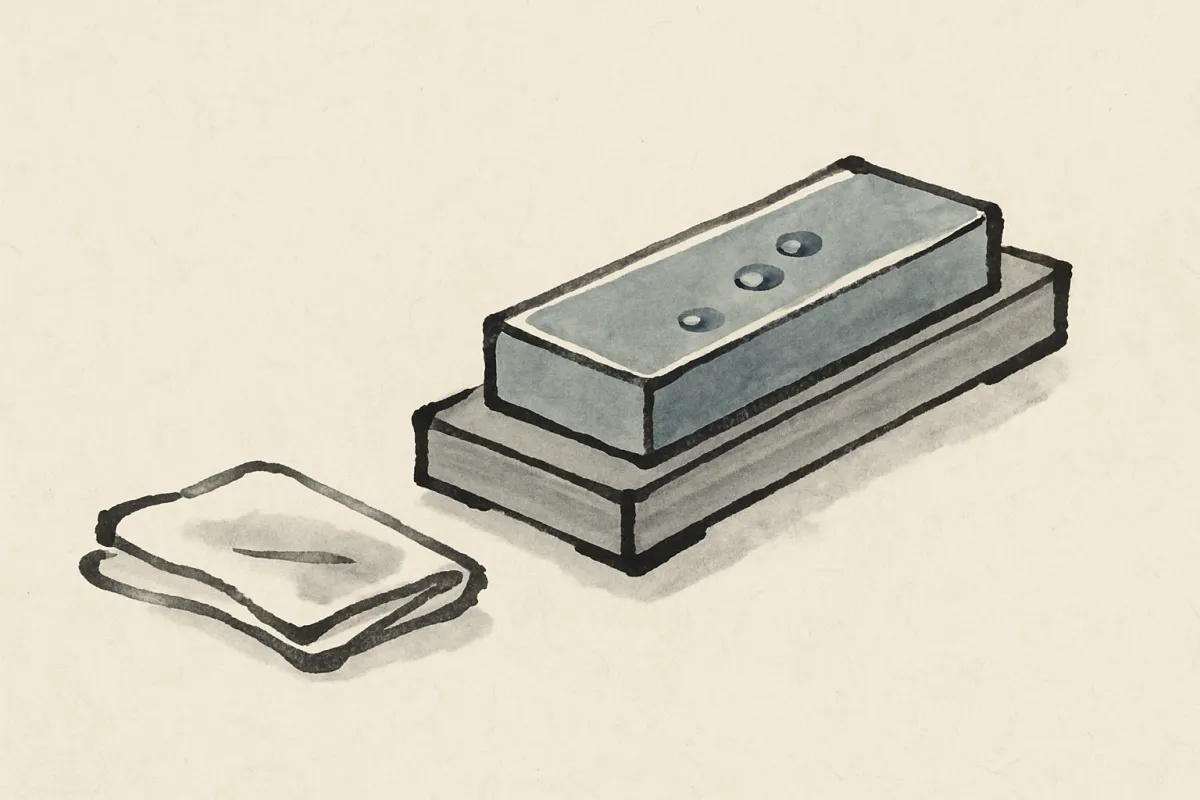
Buy a #1000 stone first. If you'd rather settle it in one purchase, get a #1000/#6000 combination. That single decision covers most home sharpening. The rest of a typical shop page is noise for now: stones from #120 to #12000, single blocks and combinations, flattening plates, something called a nagura. Almost all of it is for repairs you won't do and polish you won't notice.
Grit is just a job description
A stone's grit number is the size of its abrasive particles: higher number, finer finish. Each range maps to one job. Read the grit number as the job the stone does, and the catalog sorts into three bands.
| Band (Japanese / English) | Grit range | The job | How often you need it at home |
|---|---|---|---|
| Arato / coarse (荒砥) | #120–400 | Grind out chips, reset a wrecked edge | Almost never — only when damaged |
| Nakato / medium (中砥) | #800–2000 (#1000) | Put a new, sharp edge on a dull knife | Every single time |
| Shiageto / finishing (仕上げ砥) | #3000–8000 | Polish and refine an edge that's already sharp | Optional, nice to have |
| Mirror / polishing | #8000+ | Cosmetic mirror finish | A preference, not a performance gain |
The mistake beginners make is thinking a higher number means a better stone, so they reach for the finest one. But a #8000 stone can't sharpen a dull knife; it only polishes an edge that's already there. A coarse stone doesn't so much sharpen as demolish. Turning a dull edge back into a keen one happens in the middle band.
The one stone that does the work
That middle band is why the answer is so consistent across specialists: buy a #1000 first, and if you buy only one stone, this is it. Jon Broida of Japanese Knife Imports, who has taught sharpening for years, puts it plainly: the 800–2000 grit medium stone is the most important stone in any collection, because the medium stone is what brings a dull edge back. Coarse stones just do damage repair; finishing stones just shine up work that's already done.
If you'd rather buy once and not think about it again, get a #1000/#6000 combination stone: one block with a coarse side and a fine side. The #1000 does the sharpening, the #6000 refines the edge to a cleaner, glossier finish, and between them they cover roughly 90% of home sharpening. Hasu-Seizo calls a 1000/6000 (or 1000/3000) combo a fantastic starter for home cooks and professionals alike. King makes the classic budget version; Shapton and Naniwa make faster ones. The grit matters more than the brand.
Where to stop, and what to skip
Finishing: if you go past #1000, stop around #4000–#6000. Chasing a finer mirror can backfire. An edge polished too fine goes toothless: it loses the microscopic "bite" that grabs the surface of a tomato or a piece of meat, so it can skate instead of catching. Stones above #8000 exist, but as Oishya bluntly puts it, past about #10000 you get no measurable improvement in how the knife cuts. That's polish for the eyes, not the edge.
Coarse (#220–#400): skip it. It's a repair tool, not a sharpening stone. Reaching for coarse grit as your starting point just grinds away steel you didn't need to lose and thins the blade prematurely. The day you actually chip an edge, buy one then.
Nagura: skip it too, for now. A nagura is a small stone you rub on a finishing stone to raise a slurry. It's genuinely useful on natural finishing stones, but essentially unnecessary on the synthetic stones a beginner should be buying. It's an accessory for a problem you don't have yet.
Keeping the stone flat
The grit conversation almost always skips this: you also need to keep the stone flat, and that's not optional.
Japanese water stones cut well precisely because their binder is soft: it crumbles as you work, constantly exposing fresh abrasive. That same softness means the stone wears a hollow in the middle with use. And a dished stone ruins your edge. Hasu-Seizo notes that a hollowed stone makes angle control nearly impossible, rounding the very edge you're trying to sharpen. No technique survives a concave stone.
So the minimum kit is not one stone but two: a #1000 (or #1000/#6000 combo) plus a cheap way to flatten it. A diamond flattening plate (#400 is the standard) is the durable choice; a piece of #180–240 wet-and-dry sandpaper on glass is the budget one. The habit is "flatten lightly and often," a quick pass every session rather than a rescue job once it's badly dished.
That's the entire buy. One medium stone, or a medium/fine combo, and a flattener. Not the coarse stone, not the #12000 mirror, not the nagura.
One caveat before you check out
All of the above assumes a double-bevel knife (a gyuto, santoku, nakiri, or petty) sharpened on a water stone, the standard for hard Japanese steel; skip pull-through gadgets and oil stones entirely. If you own a single-bevel knife like a yanagiba, the finishing stone matters more and the technique differs, so read single-bevel vs double-bevel first. And your steel changes the feel: softer carbon steel bites into the stone easily, while hard, chromium-rich stainless fights it. Worth knowing which camp yours is in, from the steel guide.
Otherwise, you're done deciding. Put a #1000 and a flattener in the cart, keep the daily care simple, and go read how to actually sharpen on it. The hard part was never choosing the stone.