
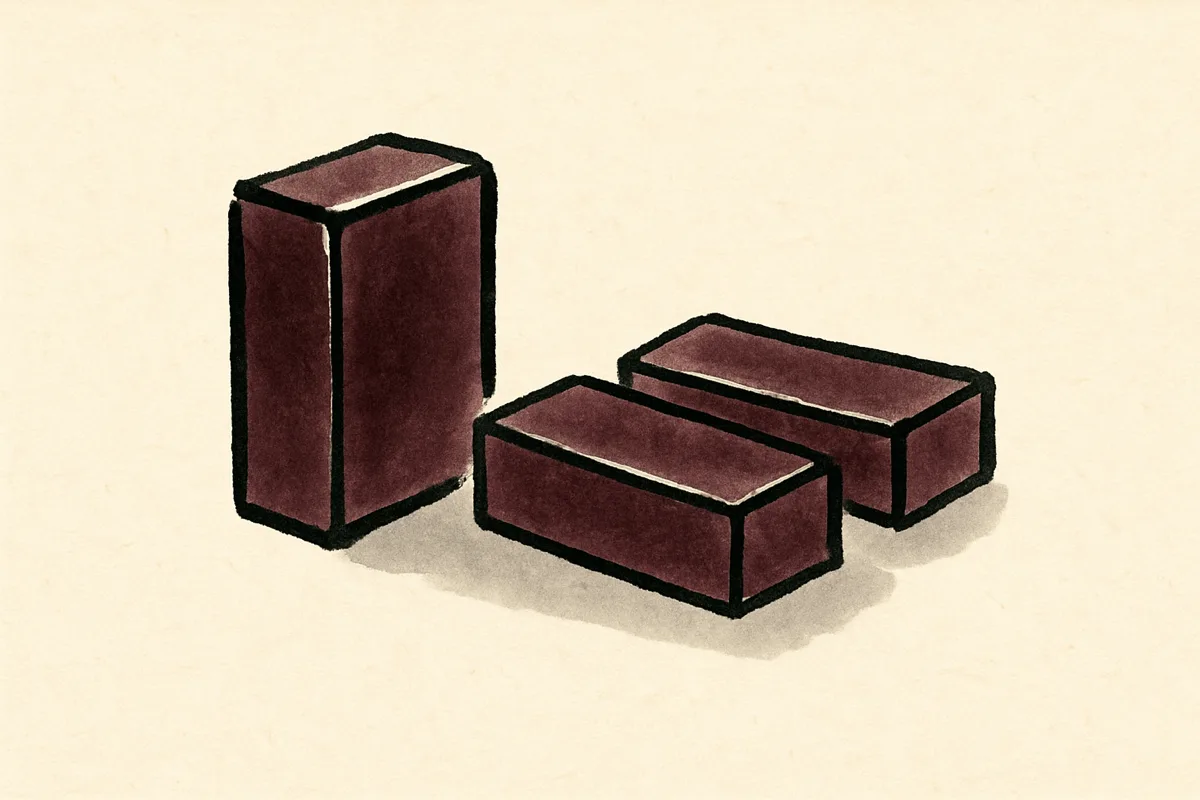
Somewhere along the way you've probably met yokan: a heavy, dark, glossy block handed to you with strong tea, sliced neat as a bar of soap; or a small foil-wrapped brick in a souvenir box or a disaster kit, stamped with a shelf life measured in years. And the questions that follow are the right ones: what is this, exactly? Is it jelly? Why on earth does it keep so long? Yokan is one of the oldest of the wagashi, and quietly one of the more interesting, and the short answer is that it's anko in its set, sliceable form.
What yokan is: anko, set with agar
Strip it down and yokan is sweet red bean paste, agar, and a lot of sugar boiled together, poured into a mold and left to set into a firm block that you slice. If anko is the foundation of Japanese sweets, azuki beans simmered with sugar into paste, then yokan is what happens when you fix that paste into a solid. The setting agent is kanten (agar), the seaweed-derived gelling powder that holds firm at room temperature where animal gelatin would melt. So yokan stands at a crossroads: it's an anko sweet and an agar sweet at once, which is why it turns up as a spoke of both stories.
The name is stranger than the sweet. 羊羹 literally reads "sheep broth": 羊 (sheep) plus 羹 (a hot stew or soup). It began in China as a mutton soup, or the jellied stock that formed when the broth cooled. When it reached Japan with Zen Buddhism in the Kamakura-to-Muromachi centuries, the monks, who avoided meat, rebuilt it with beans and wheat instead, and the meat jelly quietly became a vegetarian sweet. It arrived as tenshin, a light meal taken with tea, listed in old texts alongside udon and manjū.
Neri, mizu, mushi: reading the three types
The single most useful thing to know is that "yokan" covers three quite different textures, separated by how it's set:
| Type | How it's set | Texture | When you meet it |
|---|---|---|---|
| Neri yokan (練り) | Bean paste + agar boiled down and pressed firm | Dense, smooth, cleanly sliceable | Year-round; the mainstream type; keeps longest |
| Mizu yokan (水) | Much more water, only a little agar | Soft, wobbly, jelly-like, refreshing | Chilled in summer |
| Mushi yokan (蒸し) | Steamed, set with wheat flour or kudzu — no agar | Chewy, old-fashioned, springy | Year-round; chestnut kuri mushi yokan is the classic |
That third type is a living fossil. Mushi yokan is the older form, from before agar became common: instead of gelling with kanten, the paste is bound with wheat-flour or kudzu starch and steamed solid. The modern, firm neri yokan that most people picture only spread once agar was widespread. By tradition a Suruga-ya confectioner is credited with inventing the firm bar-shaped neri yokan in 1589, though other accounts place its real popularization in the late 18th century in Edo. (Early yokan wasn't even very sweet; refined sugar only took over after Okinawan brown-sugar production grew in the 17th century.)
Mizu yokan carries a lovely quirk of the calendar. It's a summer sweet, served cold and jiggling to beat the heat — except in Fukui, where it's eaten in winter, because the cold weather helps it set and keep. A summer sweet turned winter tradition: the sort of local inversion that makes the map of Japanese sweets more interesting than it looks (more on that in wagashi and the seasons).
The sweet that doesn't spoil — and went to space
This is yokan's real party trick. Most wagashi are heartbreakingly perishable: mochi, fresh anko, and dango go stale within a day. Yokan is the exception. Its very high sugar concentration works as a natural preservative, and a sealed block of neri yokan can sit at room temperature, no refrigeration, for years. That's not a marketing flourish; it's why yokan was prized as travelers' food during the Edo travel boom, light and durable in a pack.
Modern Japan has industrialized that shelf life into disaster preparedness. Imuraya's "Eiyo-Kan" (栄養羊羹, "nutrition yokan") is a fixture of emergency kits: a single 60 g bar packing about 171 kcal, engineered to keep for roughly five years at room temperature, made without Japan's 28 major allergens, its wrapper even printed with instructions for the disaster message dial (171). When Imuraya released a longer-life chocolate-and-bean yokan in 2008, it sold 30 million units, and the company later pushed the shelf life from three and a half years to five and a half without hurting the flavor.
And it kept going up. Yokan is certified JAXA space food: two kinds, ogura (red bean) and kuri (chestnut) neri yokan, ride to the International Space Station. Each is a 62 g pouch (ogura about 173 kcal, kuri about 175), good for roughly a year, achieved through tight control of ingredient quality, boiling temperature and time, and packaging. In orbit it needs no cooking: astronauts eat it straight from the pouch, its excellent keeping quality suiting the constraints of spaceflight perfectly. A sweet that began as a Chinese sheep soup, rebuilt by vegetarian monks, now floats in a spacecraft.
Its place at the tea table
None of this is why it's revered, though. Yokan spread from temples to court nobles to the warrior class and into the way of tea, and by the Sengoku era it was a sweet held in high regard at tea gatherings — sliced from its bar form to accompany strong tea (see wagashi and the tea ceremony). The Kyoto house Toraya is famous for it; its signature neri yokan, Yoru no Ume ("plum in the night"), is named for the flecks of bean that surface in the dark block like blossoms in the dusk — though even Toraya's earliest mainstay was the older steamed kind.
So the next time a firm dark block turns up with your tea, or a foil brick with a five-year date lands in your emergency kit, you'll know they're the same sweet: anko set with agar and sugar, the one wagashi built to last.