
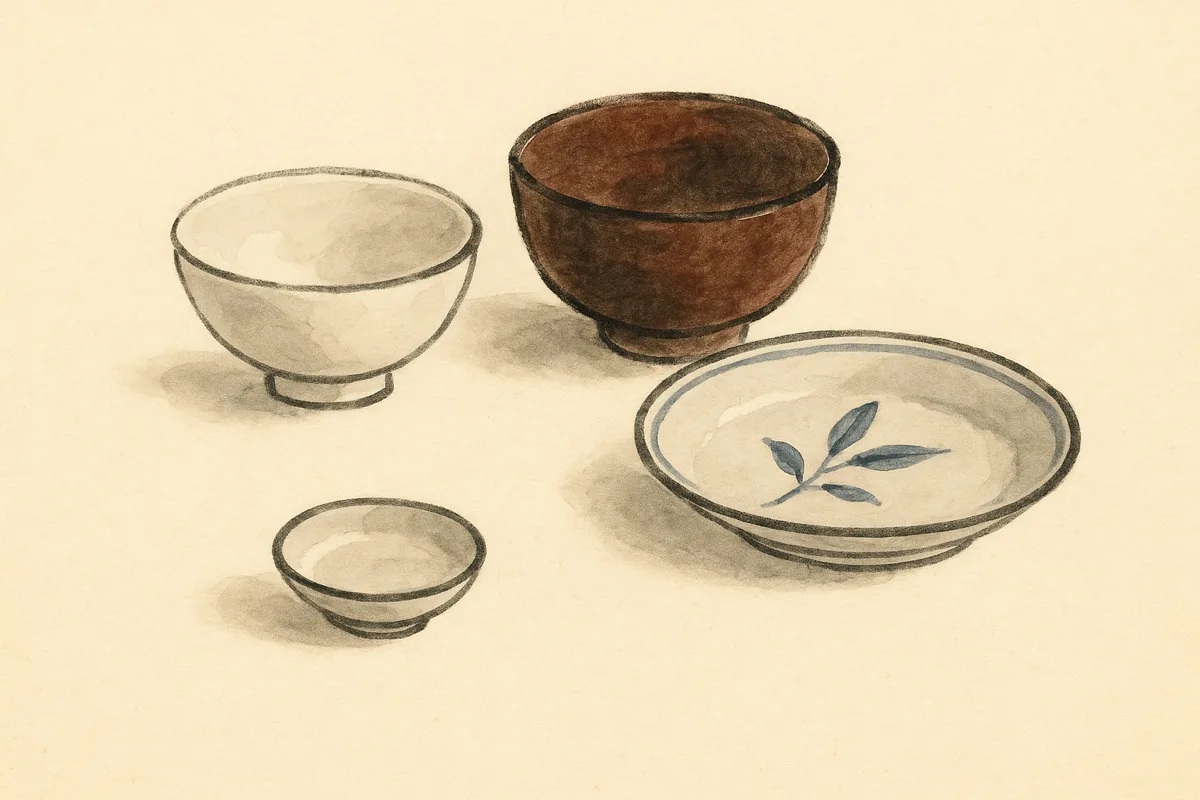
A Western table is built around the matched set: eight of everything, same pattern, same size, bought as one box. A Japanese table works the other way. Nothing matches, sizes vary on purpose, and each diner owns their own rice bowl the way they own a toothbrush. The wall of near-identical dishes turns orderly once you sort it by job rather than by set. Learn three families and one measuring stick, and the cabinet starts to make sense.
The measuring stick: sun
Japanese vessels are still sized in an old unit, the sun (寸). One sun is about 3.03 cm, and ten sun make one shaku (尺), 30.3 cm. So a "5-sun plate" is roughly 15 cm across, and an "8-sun plate" is about 24 cm. Once you read sizes this way, a shop listing stops being a wall of numbers: in this system, the size tells you the use.
Three families: plate, held bowl, in-between
Everything divides into three broad shapes:
- Sara (皿), the plate: flat and shallow, for laying food out, plating a main, or passing something around.
- Wan (碗/椀), the held bowl: deep, made to be picked up in the hand for rice, soup, or tea.
- Hachi (鉢), the in-between: taller than a plate, shallower than a held bowl, for piling up a saucy side or a mounded dish.
The line between a deep plate and a shallow hachi is genuinely fuzzy; potters call the same form by whichever name they like. It works better as three centers of gravity than as a hard boundary.
Plates, where size is the whole story
With plates, the diameter tells you the job. Everything hangs off this ladder:
| Plate | Sun / size | What it's for |
|---|---|---|
| Mamezara 豆皿 | 3 sun / ~9 cm | Soy sauce, condiments, a pinch of pickle. Descends from the old salt dish (teshiozara). |
| Kozara 小皿 | 4 sun / ~12 cm | Small sides, a sweet, an individual dipping plate. |
| Chūzara 中皿 | 5–7 sun / 15–21 cm | One person's main course; the workhorse, used more than any other. |
| Ōzara 大皿 | 8 sun+ / 24 cm+ | A shared platter for several people; a one-plate meal. |
If you buy nothing else, buy the middle of that ladder: a 7-sun plate for a main and a 5-sun plate for sides and for taking a share off a communal dish (that role has its own name, meimeizara, the "individual plate"). Those two diameters carry most meals.
Shops and guides sometimes stretch "mamezara" up to around 12 cm. A 12 cm dish is really a kobachi, a small bowl from a different family. A true mamezara is a tiny plate, about 9 cm (3 sun). Keep the plate ladder and the bowl ladder separate to avoid the mix-up.
Bowls you pick up
The held bowls are the intimate end of the cabinet. You lift them, so their weight and lip matter as much as their look.
| Bowl | Size / capacity | Material | Job |
|---|---|---|---|
| Rice bowl 茶碗 | ~12 × 6 cm, ~150 g (a woman's often ~11.4 × 5.7 cm, ~130 g) | Ceramic | One portion of steamed rice; held to eat. |
| Soup bowl 汁椀 | ~12 × 6 cm, 220–280 ml | Wood / lacquer | Miso or clear soup; drunk from the bowl. |
| Donburi 丼 | ~15 × 8.5 cm, ~900 ml | Ceramic | Rice-bowl dishes (gyūdon, oyakodon). A form that spread in the Edo period. |
| Mushi-wan 蒸し碗 | ~8 × 8.5 cm, 200–230 ml, lidded | Heatproof | Chawanmushi and small steamed dishes. |
The soup bowl is the exception: lacquered wood, not ceramic. You drink soup straight from it, both hands cupped around it, and wood barely conducts heat, so the bowl stays cool enough to hold and light enough to lift while the soup inside is hot.
For saucy sides there's a matching bowl ladder: kobachi (small, under ~13 cm) for a single-serving dressed vegetable or vinegared dish, chūbachi (13–21 cm) for a simmered dish or a personal salad, ōbachi (over 21 cm) for a serving bowl to pass around. One more to know is the mukōzuke, a roughly 5-sun bowl that holds the sashimi course in a kaiseki meal. Its name means "placed on the far side," and it sits at the back of the tray from the first course to the last.
Where everything goes: the one-soup-three-dishes layout
The everyday Japanese meal has a name, ichijū-sansai (一汁三菜), "one soup, three dishes": rice, one soup, and three side dishes (a main and two smaller ones). Pickles don't count toward the three; they're their own thing. And each vessel has an assigned seat on the tray.
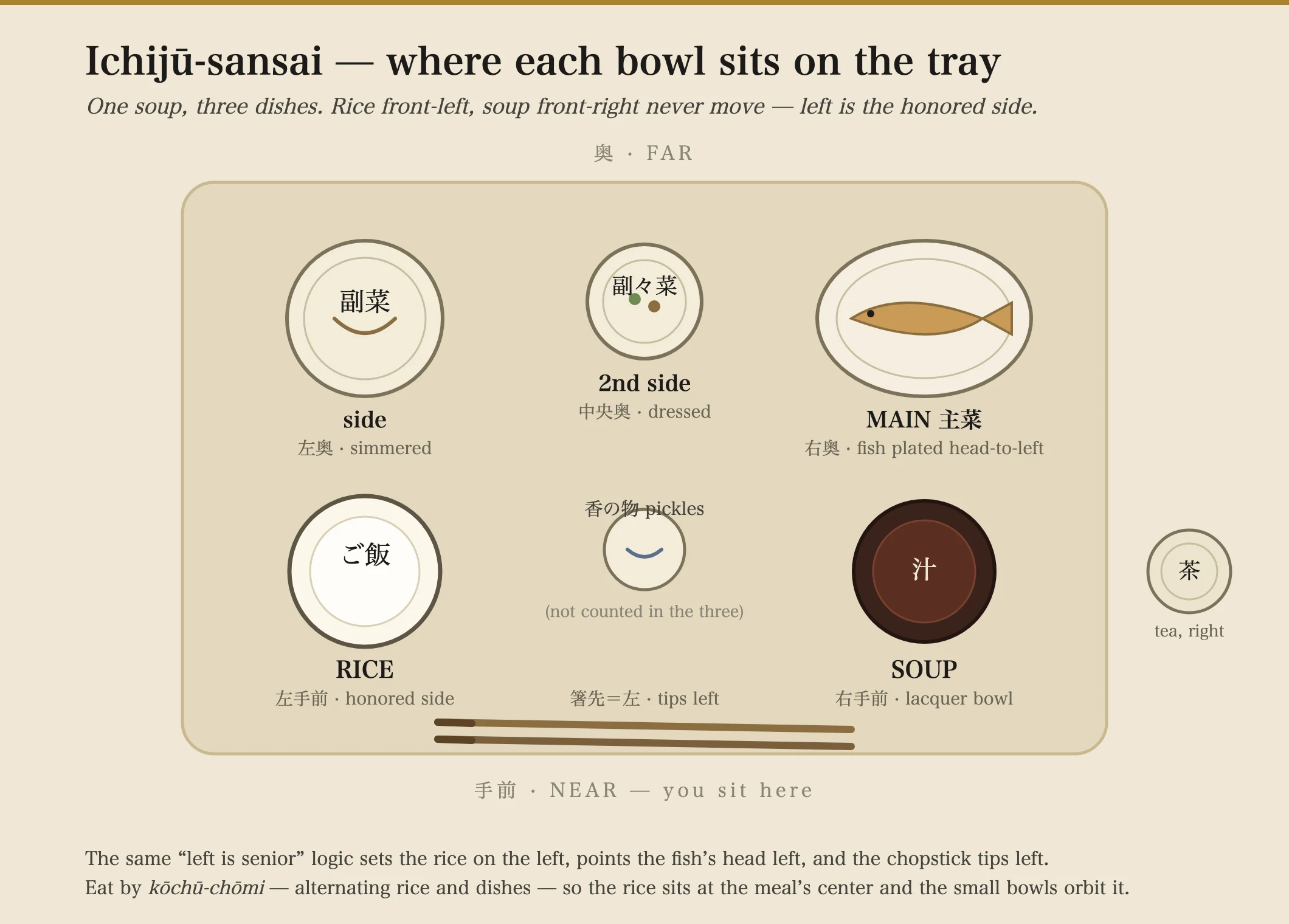
The anchors that never move: rice front-left, soup front-right. The main dish goes back-right, where your right hand reaches it most easily; the simmered side goes back-left, and a small bowl of something dressed or vinegared sits center-back. Pickles go in the middle, near the rice. The chopsticks lie flat across the very front, tips pointing left.
Rice sits on the left for two reasons. The cultural one is left-as-honor (左上位), an idea that arrived from China and is summed up as "the emperor faces south": from a south-facing throne, the left hand points east, to the rising sun, the senior direction. Rice, the staple, gets that seat of honor. The same logic runs right through the table: a whole grilled fish is plated head-to-the-left, and the chopstick tips point left, too. The practical reason rides alongside it. Most people are right-handed, and the bowl you lift most, the rice, is easiest to pick up from the left while the right hand works the chopsticks. (The exact origin of "left is senior" is argued over; a Shintō reading and the Chinese one both circulate, but the practical fit is what made it stick.)
The layout also encodes how you eat. The Japanese habit is kōchū-chōmi (口中調味): you alternate rice and a bit of the dish, letting them mingle in the mouth, rather than clearing one bowl before starting the next. Eating "only one thing at a time" is quietly frowned on. Because you alternate rice and dish, rice sits at the center of the meal and the small dishes orbit it.
The form itself is old. It crystallized in the honzen-ryōri of the Muromachi era, the ceremonial banquet style of the warrior class, with roots in Heian aristocratic feasts and its manners fixed by the mid-Edo period. The tea ceremony's kaiseki meal, pared down from honzen, keeps ichijū-sansai as its base. (Don't confuse it with the similar-sounding kaiseki banquet, 会席, a later drinking-party course.)
Nothing is supposed to match
For anyone raised on dinner sets, the mismatch is deliberate, not a failure of coordination. Japanese vessels are chosen by toriawase (取り合わせ), deliberately combining different origins, materials, and shapes into one balanced spread. A blue-and-white porcelain plate, a dark unglazed stoneware bowl, a lacquer soup cup, a little glass dish in summer: the harmony comes from the variety, not from uniformity. Food is plated to be read with the eyes, with empty space left on the dish as part of the picture.
Season drives the choice, too. Glass and pale celadon in summer to suggest coolness; thick, deep, heat-holding stoneware in winter. This is no small custom. When UNESCO added washoku to its list of Intangible Cultural Heritage on 4 December 2013, one of the pillars it named was expressing the beauty of the seasons at the table, explicitly through "dishes and other utensils that reflect the changing seasons." The vessel is officially treated as part of the meal.
It's the same taste that runs through wabi-sabi, the preference for the uneven, the handmade, the quietly imperfect over the flawless matched set. And it's why the vessels themselves reward knowing your stoneware from your porcelain and your kiln regions: the toriawase is only interesting if the pieces have something to say to each other. Start with a rice bowl, a lacquer soup bowl, and those two plates (7-sun and 5-sun) per person, and you can set a proper table tonight. From there, collecting is a matter of letting the cabinet stay happily mismatched, and caring for each piece by its material.