
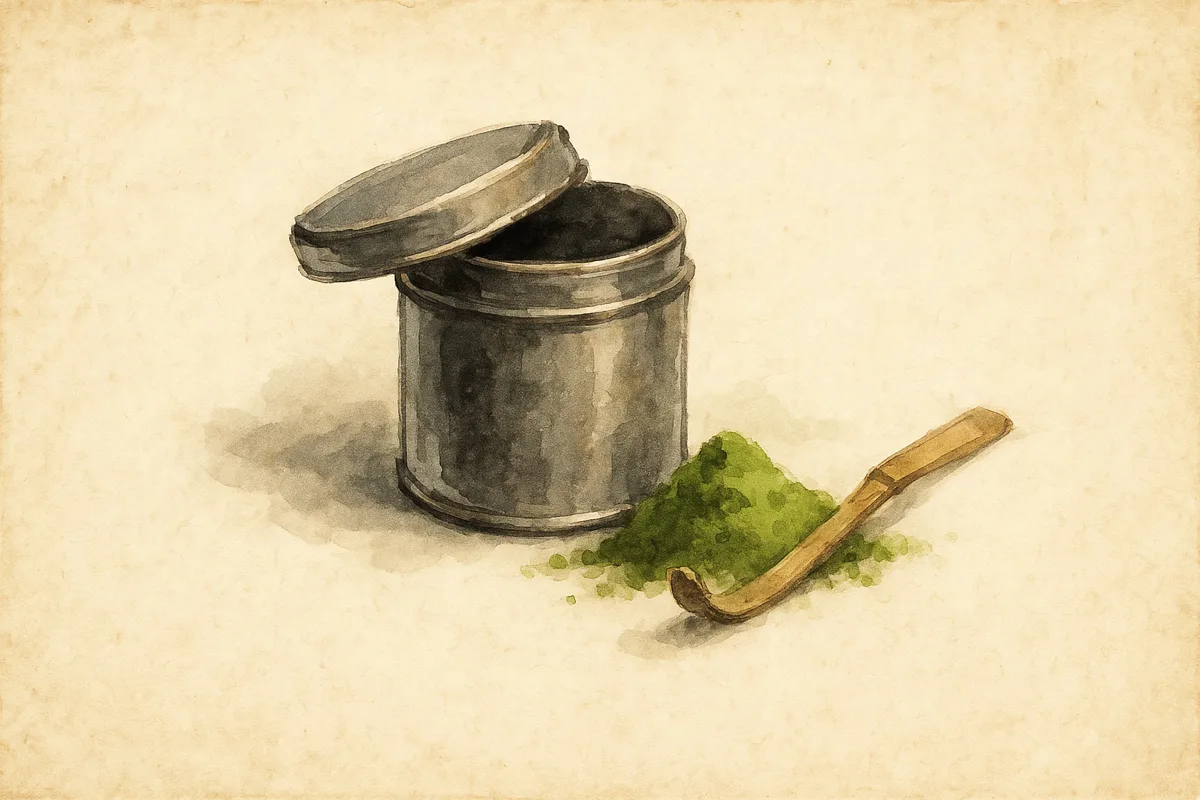
A few weeks after opening a tin of ceremonial matcha, the green looks duller and the smell flatter than before. Search whether matcha goes bad and most shop blogs repeat the same advice: airtight, cool, dark. That is true but incomplete. They skip a counter-intuitive mistake that ruins matcha faster than leaving the lid off, and they mostly get the shelf life wrong.
The fuller picture comes from what Japanese producers publish and what the food-science literature measured.
Matcha doesn't spoil, it fades
Matcha oxidizes and goes stale long before it ever becomes unsafe. When people say it has "gone bad," they usually mean the flavor has flattened, which is a separate question from whether it is still safe to drink.
Spoiling means unsafe to eat. For a dry powder like matcha, that essentially only happens one way: mold, which grows only if moisture gets in. Degrading means losing color, aroma, and antioxidant potency. That is the normal, inevitable fate of any matcha, and it stays safe the whole time. Taste of Tea makes the same point: matcha doesn't expire so much as pass its best-by date, and the real spoilage case is moisture leading to mold, which you don't drink.
Two chemical processes drive the dulling. The color is chlorophyll, which those shade-grown leaves overproduce; as it oxidizes it loses the magnesium at its center and turns into pheophytin, shifting the powder from vivid green toward olive and brown. One green-tea-powder study concluded the drop in chlorophyll is the major factor in color loss. Meanwhile the catechins that carry matcha's character (EGCG alone is roughly half the total) oxidize and polymerize, so the sweet, umami, nori-like notes thin out and a flat bitterness takes over. The dull color and the flat taste are the same change seen two ways.
What ages matcha: air, light, heat, moisture
Producers name the same culprits. Ippodo lists matcha's enemies as open air (oxygen), strong odors, direct sunlight, and heat. Moisture belongs on that list too, because matcha is hygroscopic and pulls water out of the air.
Temperature is the dominant lever. Kim and colleagues (2020) sealed matcha and stored it from 4°C up to 80°C for as long as two months, tracking catechins, antioxidant activity, and color; 4°C came out statistically best, while 25°C was only acceptable for about a week. A parallel study on leaf green tea over 150 days found the same slope: the warmer the storage, the faster amino acids, vitamin C, and flavor drained away. This is why producers tuck an oxygen absorber into the bag, and why good storage combines several moves at once.
Airtight, opaque, cool, dry
- Airtight. Keep matcha in a sealed container so oxygen and odors stay out. Before opening, the original foil bag with its oxygen absorber is ideal; after opening, decant into a proper caddy or roll the foil bag tight and clip it.
- Opaque. Light breaks down chlorophyll directly, so a metal tin beats a clear jar. This is also why a bright tin on the counter is a worse home than a closed cupboard.
- Cool and dark. A cupboard away from the stove, oven, and any spice or coffee shelf, since matcha readily absorbs strong smells.
- Dry. Only ever dip a dry spoon into the tin. A damp spoon is one of the main ways moisture, and eventually mold, gets in. (More on the right scoop in our matcha tools guide.)
The fridge trap
Cold storage does extend quality, but there is a catch. If you open a cold tin straight from the fridge or freezer, the temperature gap makes the powder pull condensation out of the warm room air. Yamamasa Koyamaen warns that a can opened while still cold absorbs condensing moisture, causing rapid loss of quality. That brings clumping and faster degradation.
So cold extends shelf life, but always open at room temperature. Let a sealed container warm up before you open it, 2 to 4 hours coming out of the fridge and up to about 5 hours from the freezer. Marukyu-Koyamaen gives the same room-temperature-first guidance, and notes matcha doesn't solidify in the freezer, so freezing works well when done this way.
If you drink matcha most days, a cool dark cupboard is the easier and safer choice, since it sidesteps condensation entirely. Reserve the fridge and freezer for a stash you're deliberately keeping for the long term, and pull from a small portion rather than opening the main container over and over.
How long it really lasts
The popular one-to-two-year figure is a safety estimate, not a flavor one. A dry powder is microbiologically near-inert, so it stays safe that long; but what Japanese producers actually print on the tin is far shorter.
| State | Realistic window | Source |
|---|---|---|
| Unopened, best-before (producer) | ~6–8 months from production, kept cool | Ippodo ≈6 mo, Marukyu ≈6–7 mo, Yamamasa 8 mo |
| Unopened, retail "keeps for" | 1–2 years (safe, but flavor already fading) | Consumer sites |
| Opened, peak flavor (producer) | ~1 month | Ippodo, Yamamasa |
| Opened, practical window | 60–90 days | Consumer sites |
| Frozen, unopened | ~1 year, most flavor retained | Yunomi |
Ippodo notes there's no hard expiration date, but even unopened tea steadily loses freshness after the roughly six-month best-before. So a year-old unopened tin is safe and also well past its best. Separate "safe to drink" from "worth drinking" and the shelf-life question gets clearer. Ceremonial matcha whisked on its own shows its age within about a month of opening; the same tin is still fine for a latte or baking for months more.
Checking whether it's still good
When in doubt, run down the same signals a buyer uses on a fresh tin, the reverse of the color test in our buying guide:
- Mold, or a sour / chemical smell → throw it out. This is the only absolute no.
- Color has gone dull yellow, olive, or brown → oxidized, but safe.
- Aroma has lost the fresh grassy, nori-like scent, or the powder smells of the fridge → stale.
- Taste is flat, bitter, or astringent, with the sweetness gone → past its prime.
- Whisked it gives thin, dull foam instead of a bright green crema, or feels gritty and clumped → moisture has gotten in.
Everything except mold means the same thing: safe, just not at its best. Drink it in a latte, cook with it, and next time portion a fresh tin small and keep the rest sealed, opaque, cool, and dry.
Matcha rarely dies; it fades. Nearly all of that fading is in your hands. When you're ready for a fresh tin, browse the shop.
Key facts
- Matcha degrades (loses color, aroma, potency) but is almost never unsafe. Mold is the only true discard signal, and it only appears if moisture gets in.
- Color loss is chlorophyll converting to pheophytin (losing its central magnesium); flavor loss is catechins like EGCG oxidizing, driven by oxygen, light, heat, and moisture, with temperature dominant (4°C best; 25°C acceptable ~7 days, per Kim et al., 2020).
- Store it airtight, opaque, cool, dark, and dry, and only use a dry spoon; producers include an oxygen absorber in the bag.
- The fridge trap: opening a cold tin causes condensation that accelerates degradation, so always let it return to room temperature first (~2–4 h from the fridge, ~5 h from the freezer). Daily drinkers are better off in a cool cupboard.
- Real windows: unopened best-before ~6–8 months (producers), opened 60–90 days (peak ~1 month). The "unopened 1–2 years" figure is about safety, not flavor.