
Matcha is a rare food whose price tag genuinely puzzles people. A tin the size of a shot glass can cost thirty or forty dollars, and the reason isn't marketing; it's the process. Matcha is not a plant, and it is not a blend. It is ordinary green tea leaf put through a specific chain of decisions, and every link in that chain either protects the umami, protects the green, or makes the leaf grindable. Follow the chain from field to powder and the cost, the color, and the sweetness all stop being mysterious.
Start with the plant, because that part is unremarkable. Matcha comes from the same Camellia sinensis that gives you the sencha at a Japanese restaurant; the difference isn't the species, it's what happens to the leaf. The first decision that turns a green-tea bush into matcha happens weeks before anyone picks a leaf.
Decision one: shade the field
For roughly 20 to 40 days before harvest, the tea rows are covered to block most of the sunlight. Growers add layers in stages, ending well past 90% shade, so the plants are gradually dropped into near-darkness rather than shocked into it.
Starved of light, the plant rewires its chemistry, and this is the single most important thing to understand about matcha. L-theanine, the amino acid behind matcha's savory, almost broth-like sweetness, is made mainly in the plant's roots and shipped up to the young shoots. In bright sun, the leaf breaks that theanine down and funnels it toward catechins, the compounds that taste bitter and astringent. Shade slows that conversion, so theanine piles up in the leaf instead of turning bitter, while the harsh catechins fall. In one peer-reviewed study on matcha leaf specifically (Chen et al., 2022), 20 days of shading raised the free amino acids and lowered the major catechins, exactly as the craft predicts.
At the same time, the plant compensates for the missing light by over-producing chlorophyll, the pigment it uses to capture what little light remains. The same study measured shaded leaf at about 1.4 times the chlorophyll of unshaded leaf. That is why good matcha is so shockingly green: the color is a stress response.
How the shade is built is itself a grade ladder. The cheapest method, jikagise, drapes black netting straight over the rows. Better is tana, a trellis frame that lets air move and doesn't crush the leaf. At the top sits honzu: traditional reed screens topped with straw, the method Uji growers established centuries ago. Honzu is reserved for the finest matcha and gyokuro, and it is brutally labor-intensive: the reed-and-straw covers can't even be reused between harvests. Right there, before a single leaf is picked, is one reason top matcha costs what it does.
Decision two: steam, dry flat, and devein into tencha
The best matcha uses the spring first flush (ichibancha), the tender young leaves picked around late May, hand-plucked for the top grades. Because picked tea leaf starts to oxidize immediately (that's how you'd get black tea), the leaves are rushed to the factory, usually within about a day, and steamed briefly. The steam kills the enzymes and locks the green in place. (Chinese green teas pan-fire the leaf for the same purpose; Japanese teas steam.)
Now comes the fork that defines matcha. Sencha and gyokuro are rolled after steaming, twisted into tight needles so they release flavor fast when steeped. Tencha is never rolled. Instead the steamed leaf is blown with air to shed surface moisture, then passed through a brick drying furnace until it's down to about 5% moisture, coming out flat and crisp. Skipping the rolling matters for a purely physical reason: an un-rolled, un-hardened leaf stays soft enough to later grind to dust. The rough dried product at this stage is called aracha.
The last refining step is deveining. Workers strip the stems and leaf veins out of the dried leaf and keep only the flat leaf blade. That deveined blade, and only that, is tencha, the sole raw material matcha is ever made from. Tencha is usually then rested, often for around half a year, before the final step.
Decision three: grind it slow
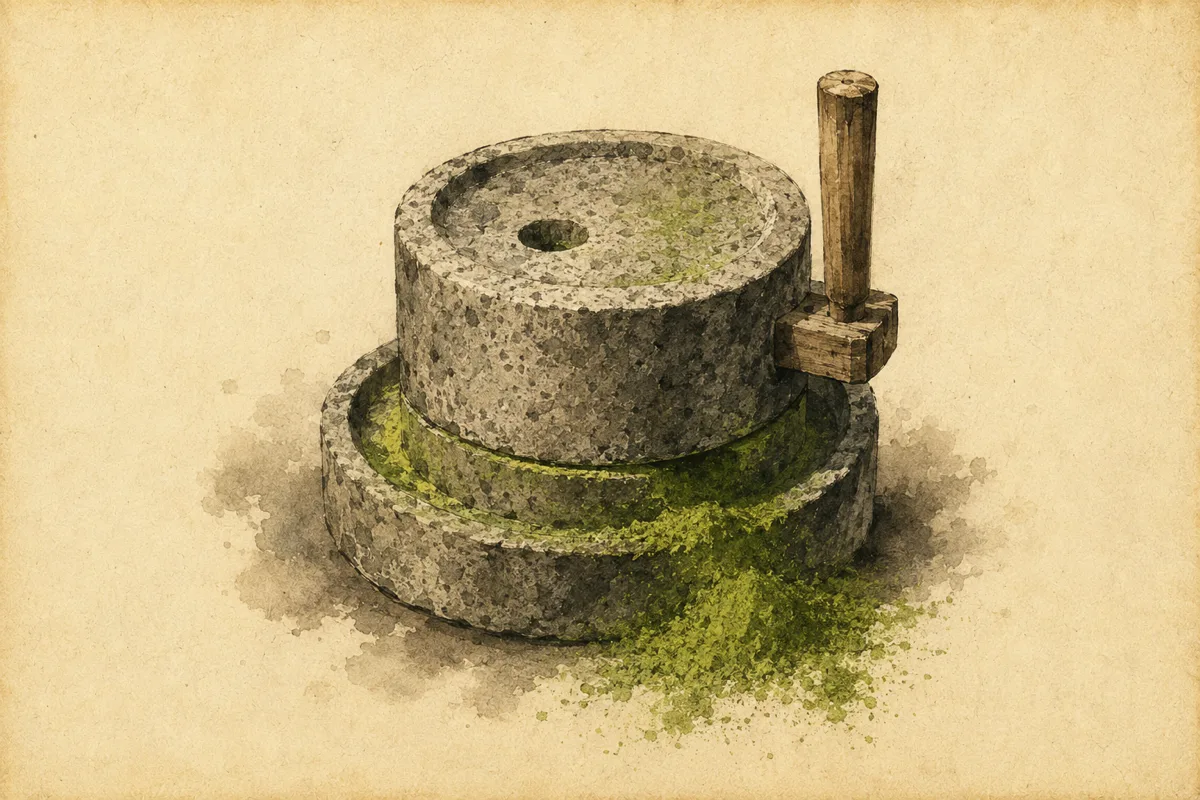
Here is where matcha's price and its supply bottleneck both live. Tencha is ground into powder on a granite stone mill (ishiusu): a heavy lower stone sits fixed while the upper stone turns slowly, about 30 rpm, crushing the leaf between grooved granite faces. Done right, it produces a powder just a few microns across, fine enough to feel like talc and to stay suspended in water, which lets you drink the whole leaf.
The number that surprises everyone: a single mill yields only about 40 grams an hour, roughly one small tin. The slowness isn't ceremony, it's physics. Spin the stone faster and friction heat climbs; above about 40°C it scorches the chlorophyll and theanine, coarsening the grain and turning the flavor bitter. A good mill stays under 30°C the whole time. The grooves themselves wear down and must be periodically re-cut by hand, a maintenance craft called medate.
That final 40-grams-an-hour step can't be sped up without ruining the product, which is exactly why a demand spike leaves the whole industry waiting on stone mills and the artisans who dress them. You can plant more bushes; you can't easily grind faster.
The chain at a glance
| Step | What happens | Why it matters |
|---|---|---|
| Shade (~20–40 days) | Field covered, most light blocked | Theanine accumulates, catechins fall, chlorophyll rises (~1.4×) |
| Harvest | First-flush leaf, top grades hand-picked | Tender young leaf carries the most umami |
| Steam (within hours) | Brief steaming stops oxidation | Locks in the green before the leaf browns |
| Dry flat — no rolling | Air-blown, then furnace to ~5% moisture (aracha) | Leaf stays soft enough to later grind to dust |
| Devein → tencha | Strip stems and veins, keep leaf blade | Tencha is the only raw material for matcha |
| Stone-mill (~40 g/hr) | Granite ishiusu, ~30 rpm, few microns | Slow to stay under 40°C and protect flavor & color |
Read the price of a good tin against that chain and it reads differently. You're paying for weeks of hand-built shade, first-flush leaf picked by hand, a leaf refined down to just its blades, and a final grinding that no one has figured out how to rush without wrecking. When you're ready to taste the difference the process makes, browse the shop, and read the grades guide to know what you're paying for.